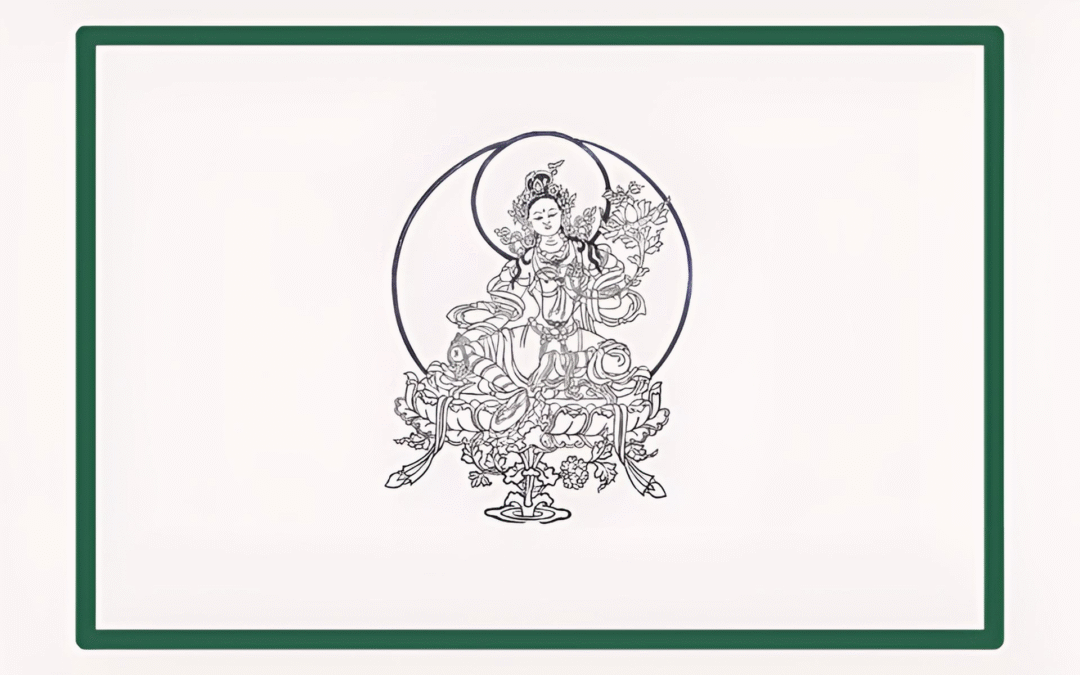
In about 1998, I recall seeing a small printed image of Green Tara on the cover of the morning puja prayer sheets at Marpa House. Green Tara was depicted in the traditional style, with black lines printed on a white background. I was a relative newcomer to Marpa House at that time, and having begun to practice Green Tara, I was having some difficulty in visualising her. To get to know Green Tara better, I decided to make a woodcut print of her.
I soon realised that the traditional Tibetan block cutting method was very different from my own. In making a black and white woodcut print, I was accustomed to cutting out just the outlines of figures and objects so that the resulting printed image was composed of white lines on a black background. I was intrigued by the contrasting Tibetan process, where much of the surface of the wood block is cut away, leaving only the outlines of forms and figures in high relief, producing a black line print on a white background. I decided to try this Tibetan approach.
I enlarged the small Green Tara print on the puja prayers and transferred a carbon copy of the design onto a piece of plywood. Then I cut away all the surface wood of the background, leaving the linear form of Green Tara raised. Finally, I rolled black ink over the raised lines and made several prints from the block on my Western printing press.
I have thought long and hard about this beautiful image of Green Tara and what her linear form on a white sheet of paper means for me. Perhaps in the past, I had focused on the print, unaware of the equal value of the space essential for her creation. I began to see that the spaces between the lines are as important as the lines themselves. You cannot have one without the other!
Through the Tibetan wood cutting method, Green Tara appears in the finest filigree of interwoven lines that simply describe her essential qualities without embellishment of unnecessary form. Here is her spirit of lightness, her reassurance and ready support in a troubled world.
Rinpoche once said that Tibetan paper is the best in the world. I used Nepalese paper for Green Tara, a paper which is a pretty good ‘second best’. Unlike machine-made papers, which are easy to tear because the fibres flow uniformly in one direction, this paper is made of natural vegetable fibres crushed and strewn in all directions…a bit like the spread of Buddhism! You cannot tear Tibetan or Nepalese paper without applying a lot of pressure. Unlike machine-made papers, it does not rot. In short, it is very strong and reliable. This paper upon which sits eternal Green Tara, has a long and beautiful life.
ADDRESS
Marpa House,
Rectory Lane, Ashdon,
Saffron Walden, Essex
CB10 2HN
United Kingdom
CONTACT
T: +44 (0) 1799 584 415
E: mail@marpahouse.org.uk
“One sky, one mind”
Kyabje Chime Rinpoche
Marpa House is conducted by The Dharma Trust, a company limited by guarantee (no. 04332473) and registered with the Charity Commission (no. 1090628).
Photographs © The Dharma Trust or Kyabje Chime Rinpoche unless stated 2026. All rights reserved. Not to be reproduced without permission.